Supplier Quality – Why Product Quality Begins Long Before the Production Line
Product quality does not begin on the production line. How can supplier selection, capability assessment, requirement definition, and continuous improvement management prevent issues before they reach the organization?
In this insight you will learn
- A supplier providing a component that affects product performance effectively becomes part of the organization's quality system.
- Supplier assessment is not just a score; it is understanding the level of risk and capability before the organization becomes dependent on them.
- Pre-Production quality examines process capability, testing methods, and understanding of requirements before serial production.
- Incoming inspection reveals problems that have already occurred; effective supplier management shifts control toward prevention.
- Non-conformities are addressed using root cause analysis and 8D, ensuring the system that created the failure is changed.
The quality of the final product is not determined solely within the factory. Any raw material, component, or process sourced from a supplier is already part of the organization's quality system—therefore, supplier quality management is an integral part of product quality.
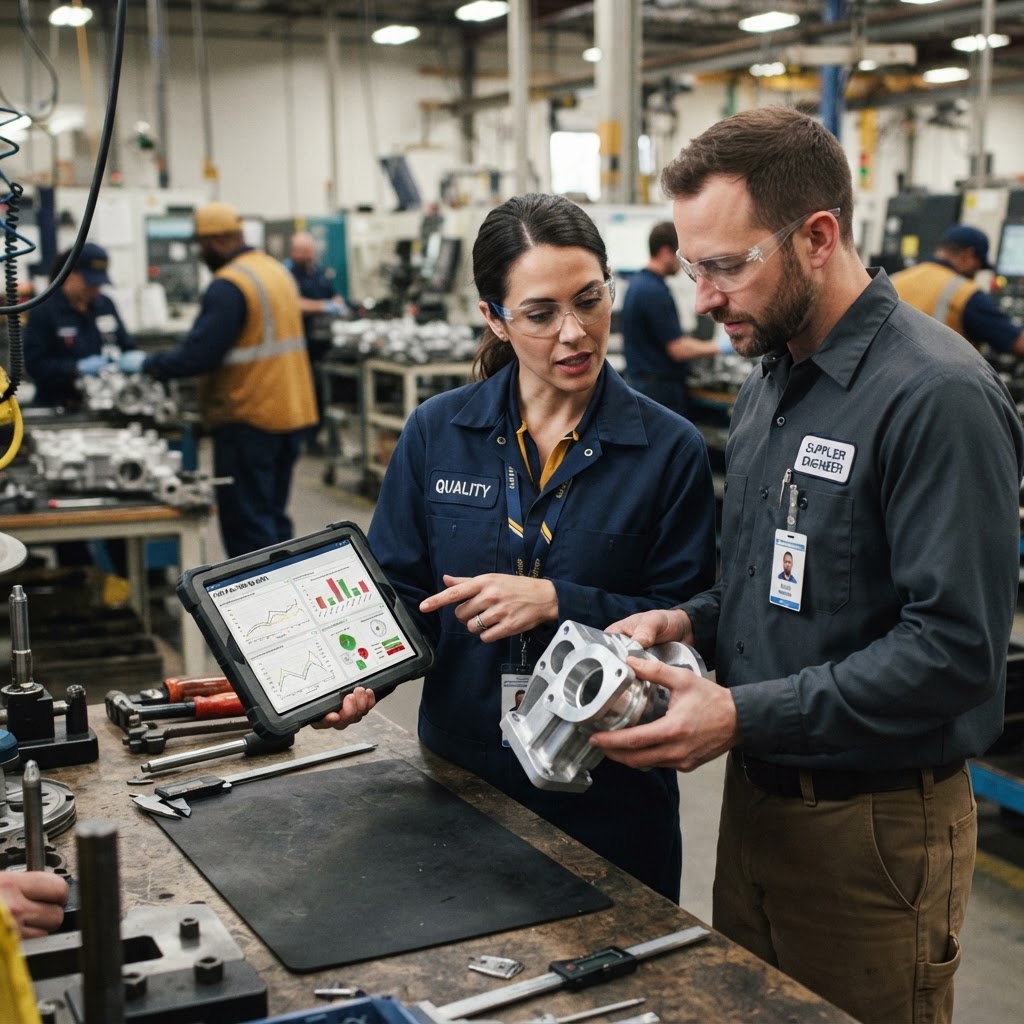
The quality of the final product is not determined solely within the factory. Any raw material, component, or process sourced from a supplier is already part of the organization's quality system—and therefore, supplier quality directly affects product quality. In an industrial world where products and systems consist of a chain of suppliers, subcontractors, and components, it is insufficient to check the product only when it arrives at the organization. Effective supplier quality management begins much earlier: with supplier selection, requirement definition, capability assessment, and building a mechanism that enables identifying and mitigating risks before they become problems in production or at the customer's site. ## A supplier is more than just a procurement source It is easy to view a supplier primarily through the lens of price, lead times, and availability. However, when the supplier provides a component, material, or process that affects product performance, they effectively become part of the organization's quality system. A deviation by the supplier can later turn into: * Production stoppage * Rejections and rework * Delivery delays * Failure investigations * The need for sorting and additional inspections * Reliability issues * Customer complaints Therefore, the question is not only "Can the supplier deliver?" The more important question is: "Can the supplier consistently deliver the quality we need?" ## Supplier assessment – before the problems start A supplier assessment should not be based on a single parameter. When dealing with a significant supplier, it is appropriate to evaluate their capability more broadly: process capability, the quality management system, controls, the ability to meet requirements, and how they manage issues and changes. The goal is not to "give a grade" to the supplier. The goal is to understand the level of risk and capability before the organization becomes dependent on them. ## Pre-Production quality – why wait for the first batch? An especially important principle is Pre-Production Quality Evaluation. When one waits for serial production to discover that a supplier cannot meet a certain requirement, the options for correction are reduced and the cost can rise. Before moving to production, it is worth examining whether: The requirements are clear and agreed upon, the process is capable of producing the required result, suitable testing methods exist, and the supplier understands the significant quality characteristics. The earlier these questions are asked, the easier it is to bridge gaps when changes are still relatively easy to implement. ## Supplier quality begins with clear requirements Sometimes, a supplier problem begins before the supplier manufactures the first item. A requirement that is not clear, a specification that can be interpreted in several ways, or a change that was not communicated in a controlled manner can create a non-conformity even with a professional supplier. Therefore, a good relationship with a supplier requires more than audits. It requires clear engineering and quality communication. What exactly is required? How will compliance with the requirement be measured? Which characteristics are critical? What requires approval before a change? The clearer the interface, the less room there is for assumptions and interpretation. ## Incoming inspection is not a substitute for supplier management Incoming inspections are an important tool, but they have a fundamental limitation: they are performed after the product has already been manufactured. If the organization relies primarily on incoming inspection, it is essentially trying to detect a problem that has already occurred. Supplier quality management aims to shift the control point backward: From detecting non-conformities – to preventing them. Instead of repeatedly increasing the scope of inspections, it is worth examining why the problem is occurring at the supplier and what is required to stabilize and improve the process. ## What happens when a problem is discovered? A non-conformity does not end when the supplier replaces the parts. If it is a significant or recurring issue, one must understand: What happened? What is the root cause? What actions were taken? How do we ensure the problem will not return? This is where supplier quality management connects to the worlds of Root Cause Analysis, Corrective Action, and 8D. The goal is not just to receive a good shipment next time, but to ensure that the system that created the failure has been changed. ## From specific improvement to improving supplier quality Supplier quality is not a one-time event during supplier approval. Even an approved supplier needs to be part of an ongoing process of monitoring, communication, and improvement. When gaps are discovered, it is correct to examine not only the isolated event but also the trend. Is the same problem recurring? Are the corrective actions effective? Is the supplier's performance improving? Are there new risks? This is how the relationship moves from a reactive state to a state of performance management and continuous improvement. ## A good supplier is a partner in quality Supplier management does not need to be based only on audits, requirements, and exceptions. In complex systems, suppliers sometimes hold very deep professional knowledge regarding the material, component, or process they provide. When the organization and the supplier work together on requirements, risks, and process improvements, it is possible to identify problems earlier and develop better solutions. This is not offloading responsibility from the supplier. On the contrary – this is creating a relationship where responsibility for quality is clear, measurable, and managed. ## Not all suppliers require the same level of control A supplier of a critical component for a system is not necessarily similar to a supplier of an item that does not affect performance or safety. Therefore, an effective supplier quality system must take the level of risk into account. The higher the supplier's impact on the product, performance, or customer, the greater the justification for deeper control. Such an approach allows the organization to invest resources where they truly have an impact. ## An industry example Suppose a supplier provides a mechanical component integrated into an assembly. In incoming inspection, the parts are within the allowed range, but during assembly, recurring problems begin to appear. One could continue to increase the scope of incoming inspections. But one could also examine the process at the supplier: Is there significant variation? Is the measurement process suitable? Are the drawing requirements understood in the same way by both parties? Did a change occur in the process or material? This investigation can reveal that the problem is not a "bad shipment," but a systemic gap. Once the gap is identified, it can be addressed instead of continuing to sort parts in every shipment. Here too, tools like FMEA can help in the early identification of risks in the interface between the organization and the supplier. ## Supplier quality is part of product quality When a significant part of the product is manufactured outside the organization, the boundary between "our quality" and "the supplier's quality" almost disappears. The end customer is not interested in who manufactured the component that caused the malfunction. As far as they are concerned, they received one product – and the responsibility for its quality lies with the organization that supplied it. Therefore, supplier management should be an integral part of the quality system and not a separate activity of the procurement department. --- ## Summary Supplier quality does not begin with incoming inspection and does not end with supplier approval. It begins with selection and requirement definition, continues with capability and quality assessment before production, and relies over time on monitoring, problem solving, and improvement. An organization that manages supplier quality systematically can move from a state of discovering problems that arrived from the supplier to a state of working together with the supplier to prevent them in advance. ### Want to strengthen your organization's supplier quality array? ALD Advanced Solutions supports organizations in the fields of quality, supplier assessment, risk management, problem solving, corrective actions, and process improvement. For a professional consultation with the ALD team
Insight from Dr. Zigmond Bluvband
“Quality is not created in the final inspection. It is created in the decisions made at the beginning of the project.”
This insight is based on professional knowledge, practical experience and study materials of ALD Advanced Solutions, and inspired by the books and publications of Dr. Zigmond Bluvband.