
Quality 4.0 – How the Quality Professional's Role is Evolving, and What Skills Will Be Required
Quality 4.0 is not just another software tool, but a shift in how an organization produces, analyzes, and uses quality data. What does this mean for the day-to-day work of quality engineers and managers, and which skills should you develop right now?
In this insight you will learn
- What is the difference between Industry 4.0 and Quality 4.0
- Why Quality 4.0 is primarily a matter of people, culture, and processes, and only secondarily about technology
- How the daily work of a quality engineer is changing
- Which five skills should be developed to remain relevant
- How to start with a small, measurable step instead of a massive digital project
The world of quality is undergoing a significant transformation. If quality was previously focused primarily on inspection, it is now becoming a strategic domain that integrates data, automation, artificial intelligence, and systems engineering.
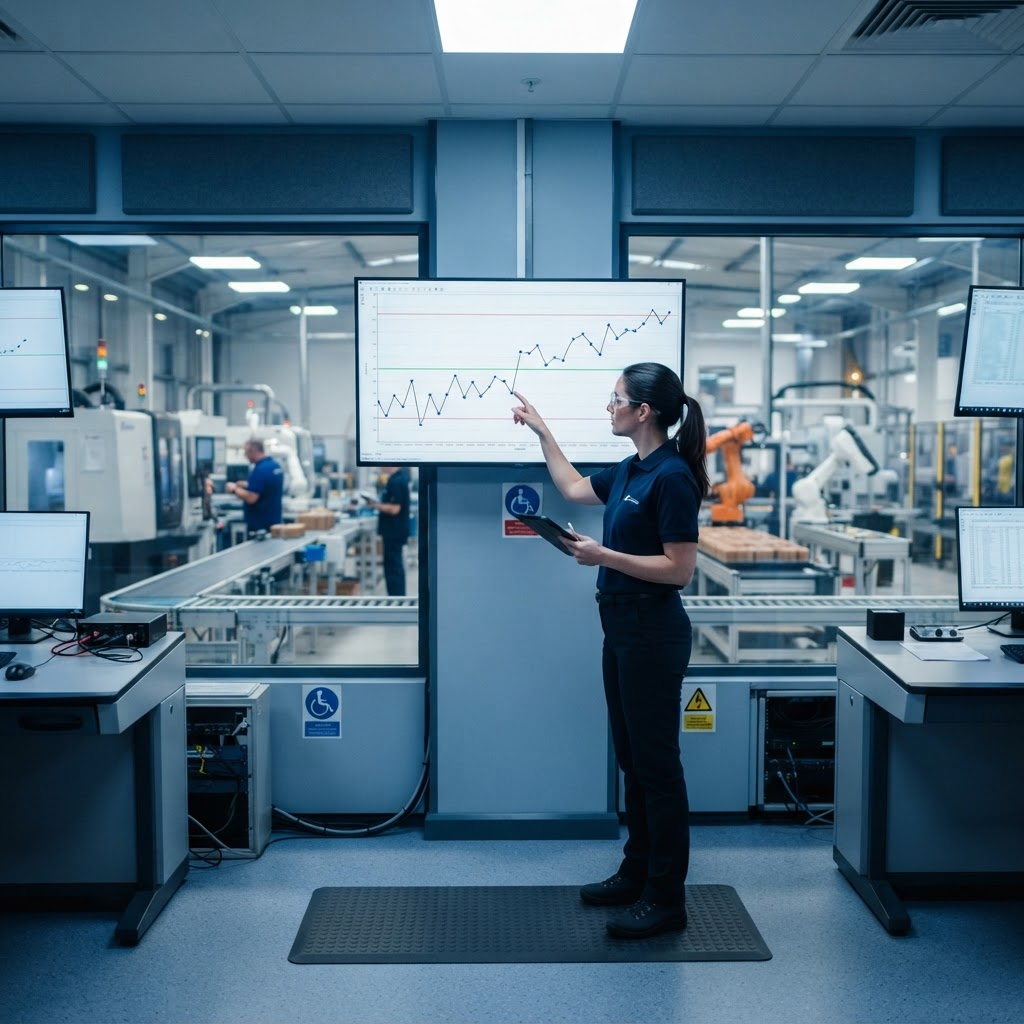
For decades, the quality professional was measured by their ability to inspect, document, and prove compliance with requirements. This role has not disappeared, but it is no longer enough. In connected production lines, systems generating data at every moment, and global supply chains, the question is no longer just 'Does the product meet the specifications?' but 'What do the data say about the process, and what shall we do with them before a problem occurs?'. This shift is called Quality 4.0. In this newsletter, we will not delve into the AI tools themselves (we wrote about that in AI in Quality Management – What can you actually do with it today?), but rather in the person behind the process: what is changing in the role, and what skills will be required. ## From Industry 4.0 to Quality 4.0 The term Industry 4.0 was introduced to the general public in 2011, at the Hannover Messe trade fair in Germany, as part of an initiative to promote connected and digital manufacturing. At its core lies the connection between machines, sensors, information systems, and people, such that data flows between production stages almost in real-time. Quality 4.0 is the application of this same concept to the world of quality: using data, connectivity, and automation to improve how an organization plans, measures, analyzes, and improves quality. The research firm LNS Research proposed a framework of 11 'axes' for Quality 4.0. Alongside technological axes like data, analytics, and connectivity, the framework also includes human and organizational axes like leadership, culture, collaboration, and employee competence. This is the most important point in this newsletter: Quality 4.0 is not an IT project. An organization that buys an advanced system without changing how people make decisions will usually just end up with another screen full of charts that no one looks at. ## What is changing in day-to-day work ### From inspection to prediction In the past, most work focused on the finished product. Today, with process data available in real-time, it is possible to identify a trend before it becomes a non-conformity. Tools like SPC and Cp/Cpk are not new, but they are evolving from monthly reports into continuous working tools. ### From data collection to interpretation The shortage is no longer in data, but in the ability to ask the right question. The quality engineer needs to know how to distinguish between noise and signal, between correlation and causation, and between random variation and variation that requires action. ### From a separate department to a partner in development As products become more complex, it is more correct to address quality and reliability issues at the design stage. Quality professionals are required to sit in design reviews, participate in FMEA, and speak a common language with reliability, safety, and systems engineers. ### From documentation to a knowledge system A digital quality management system allows for connecting customer complaints, production findings, supplier data, and corrective actions. Value is created when information is connected and allows for learning, not just when it is stored. ## Five skills to develop right now - Data literacy and statistics – A deep understanding of distributions, statistical control, design of experiments, and failure analysis. Without a statistical foundation, it is easy to be impressed by a pretty graph and reach a wrong conclusion. - Systems thinking – The ability to see the product throughout its entire life cycle: design, production, field use, and maintenance. This is where quality meets reliability and RAMS. - Risk management – Identification, evaluation, and prioritization of risks using tools like FMEA, and the understanding that data-driven decisions still require engineering judgment. - Understanding of digital tools – You don't need to be a programmer, but you must understand what a tool can do, what its data sources are, and when you should not rely on it without verification. - Leading change and communication – Most projects fail because of people, not technology. The ability to explain to management and the shop floor why changes are being made, and to present results in business terms, is a professional skill in every sense. ## Practical example: From a monthly report to real-time alerts A typical electronics factory produces a non-conformity report every month. By the time the report arrives, the problems have already reached the customer, and the team is mostly busy firefighting. The team decides to start with a small step: connecting the inspection data of one line to control charts that update by shift, and defining in advance who responds to each type of deviation and within what timeframe. The quality engineer does not build the system themselves, but they define what is measured, what counts as a deviation, and what to do when it appears. The key result is not the technology but a change in habit: the team starts discussing problems when they are still small, and learns from them. Only after the method works on one line is it expanded to others. ## Three common mistakes in the transition to Quality 4.0 ### Starting with the tool instead of the problem Many organizations choose a system first, and only then look for a use for it. The correct order is the opposite: define a real quality problem, understand what data is needed to solve it, and only then choose the appropriate tool. ### Assuming the data is correct A digital system displays numbers with great confidence, even when they are wrong. An uncalibrated sensor, an inconsistent definition of 'defect' between shifts, or a field filled in manually and inconsistently can lead to an impressive analysis and a wrong conclusion. Checking the measurement system, for example using MSA, is a prerequisite, not an optional step. ### Bypassing the people When shop floor staff or process engineers are not partners in the change, they continue working the old way, and the new system becomes just another layer of reporting. Early involvement, explaining the 'why', and showing real benefit to their work are part of the plan, not an afterthought. ## How to get started - Choose one real problem – Not 'digital transformation', but a defined problem that costs money or harms the customer. - Check data quality – Before analyzing, ensure the measurement system is reliable. Sophisticated analysis of wrong data leads to wrong decisions. - Define who decides and what is done – An alert without an owner is just noise. - Measure the impact – Determine in advance how you will know that the change worked. - Invest in people – Training in statistical and engineering foundations is just as important as the tool itself. ## Summary Quality 4.0 changes the tools, but primarily it changes the role. The quality professional moves from inspection and documentation to interpretation, prediction, and leading decisions, becoming involved earlier in the development and risk management of the organization. The basic principles remain: proper planning, reliable measurement, systematic analysis, and continuous improvement. What changes is the pace, the amount of information, and the expectation that quality professionals will know how to turn it into decisions. Those who invest today in statistical and engineering foundations, in systems thinking, and in the ability to lead change, will be in a good position to lead this transition in their organization, rather than just reacting to it. ## Further reading AI in Quality Management – What can you actually do with it today? SPC: How to know if the process is truly stable? CMQ/OE Course – Certified Manager of Quality ## The transition to Quality 4.0 requires quality managers who understand both the professional foundation and leading organizational change The CMQ/OE certification preparation course by ALD Academy covers quality management at the organizational level, and is suitable for those leading or wanting to lead this movement. Details on the CMQ/OE course
Insight from Dr. Zigmond Bluvband
“Technology changes, but the principles remain – planning, measurement, improvement, and a commitment to excellence.”
This insight is based on professional knowledge, practical experience and study materials of ALD Advanced Solutions, and inspired by the books and publications of Dr. Zigmond Bluvband.