
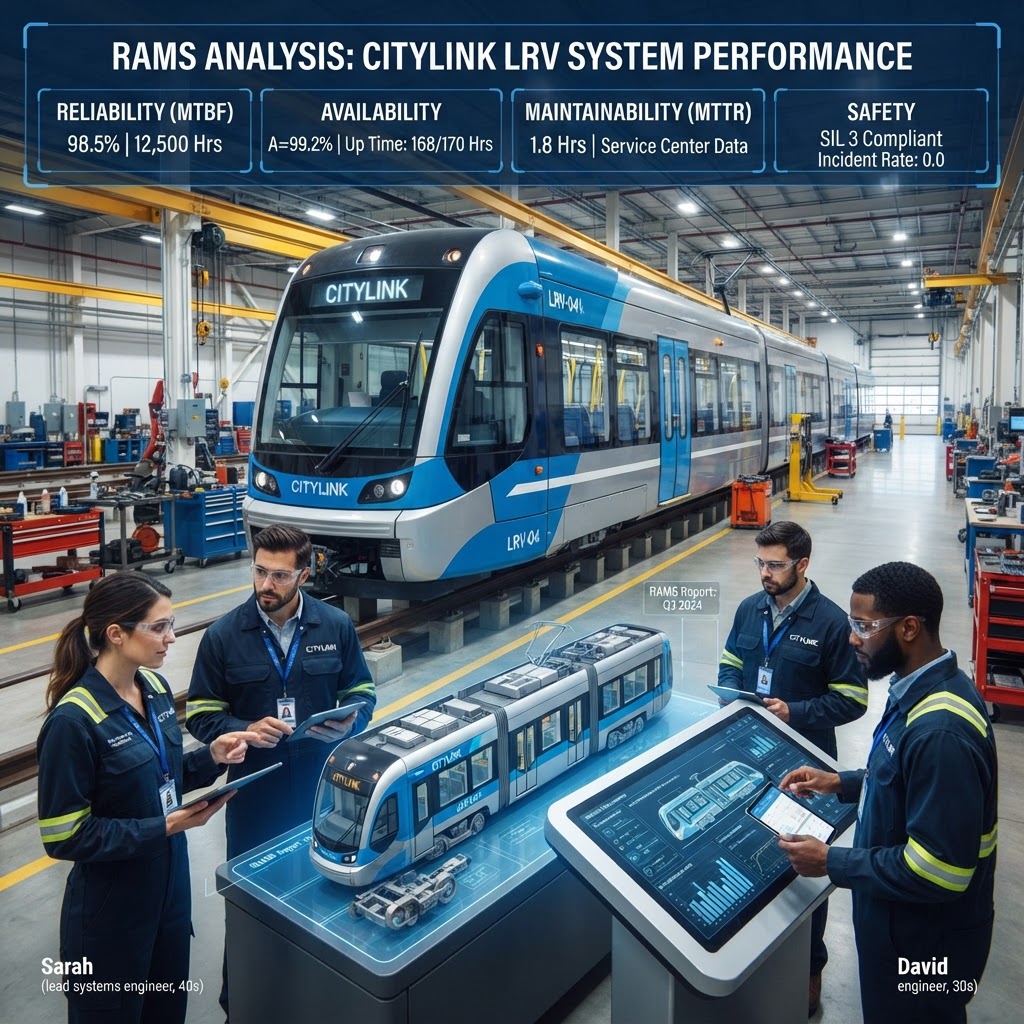
RAMS – The Basis for Safe, Reliable, and Available Systems
Why complex projects cannot succeed without the RAMS methodology
In this insight you will learn
- What are the four components of RAMS and their meanings
- How Reliability, Availability, Maintainability, and Safety interrelate
- Why RAMS is critical in railway and infrastructure projects
- How RAMS reduces life cycle costs
In a world of complex systems, product quality alone is not enough – a train can be manufactured to high quality, but if it is not available, is difficult to maintain, or is unsafe, it will not meet project objectives.
Introduction
Here comes into play the RAMS methodology, which combines four key areas:
- Reliability – Reliability
- Availability – Availability
- Maintainability – Maintainability
- Safety – Safety
This approach is currently used as a foundation in railway, aviation, security, energy, and infrastructure projects.
Reliability – Reliability
Reliability describes a system's ability to perform its intended function over time under specified working conditions.
A reliable system:
- Experiences fewer failures
- Requires fewer repairs
- Reduces operational costs
Availability – Availability
Even a reliable system may not be available. Availability measures the percentage of time that the system is capable of performing its function.
For example: A train that is out of service for repair is not available, even if the failure itself is rare.
Maintainability – Maintainability
Maintainability deals with the question: How easy and quick is it to restore the system to operation?
Proper design allows for:
- Easy access to components
- Quick replacements
- Reduced downtime
- Lower maintenance costs
Safety – Safety
Safety is the most important principle. The goal is not only to prevent accidents but also to identify risks in advance and incorporate protective measures during the design phase.
Example from a Railway Project
In a light rail system, a RAMS analysis was conducted during the design stages. The team identified that a failure in the braking system could cause the entire line to shut down.
Through redundancy, backup sensors, and new maintenance procedures, the risk was significantly reduced.
This is an example of how RAMS is not a document – but a decision-making tool.
Advantages of RAMS
- Improved reliability
- Increased availability
- More efficient maintenance
- Reduced life cycle costs
- Enhanced safety
- Compliance with international standards
Conclusion
RAMS is much more than a contractual requirement. It is a methodology that helps design safe, reliable, and efficient systems throughout their entire life cycle. In complex projects, RAMS is an essential component for success.
Insight from Dr. Zigmond Bluvband
“Quality produces a proper product. RAMS ensures it will serve us for years.”
This insight is based on professional knowledge, practical experience and study materials of ALD Advanced Solutions, and inspired by the books and publications of Dr. Zigmond Bluvband.